Clay vs Plant-Based: Which Cat Litter Wins?
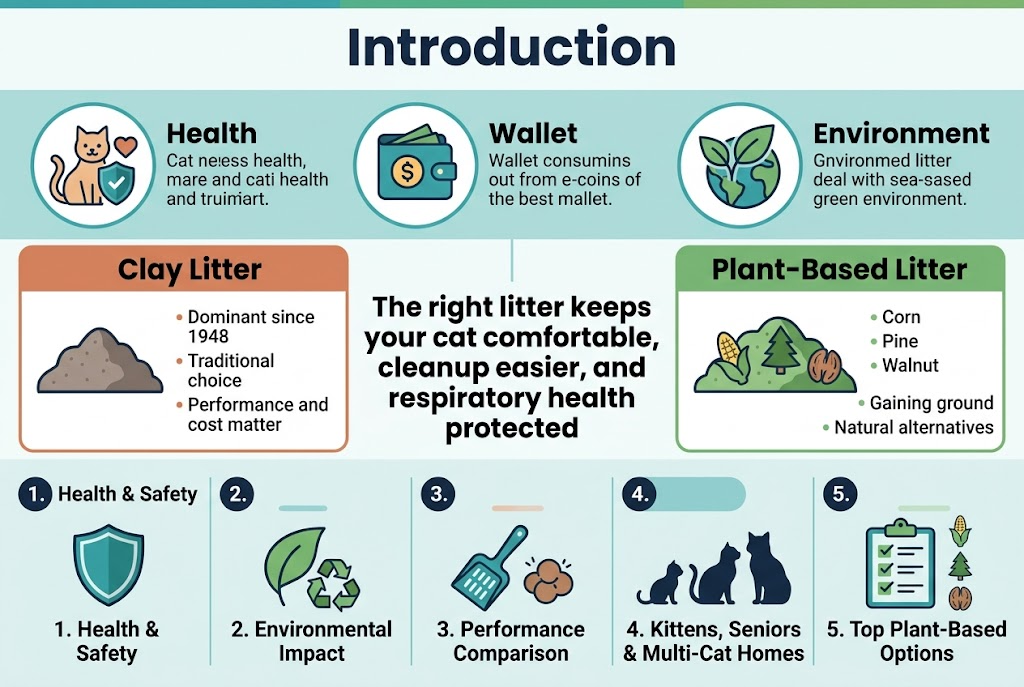
Cat parents face a big choice at the pet store: clay or plant-based litter. This decision affects your cat's health, your wallet, and the environment more than you might think.
Clay litter has dominated since 1948, but plant-based options like corn, pine, and walnut are gaining ground for good reasons. The right litter keeps your cat comfortable while making cleanup easier and protecting their respiratory health.
This guide is for cat owners wondering if it's time to make the switch from traditional clay to plant-based alternatives. We'll break down the health and safety differences that matter most for your cat's wellbeing. You'll also discover how environmental impact plays into this choice and get a practical performance comparison to see which option handles daily use better. Finally, we'll explore special considerations for kittens, senior cats, and multi-cat households, plus highlight the top plant-based options worth trying.
Understanding the Key Differences Between Clay and Plant-Based Litters
What Makes Clay Litter Work and Why It Dominates the Market
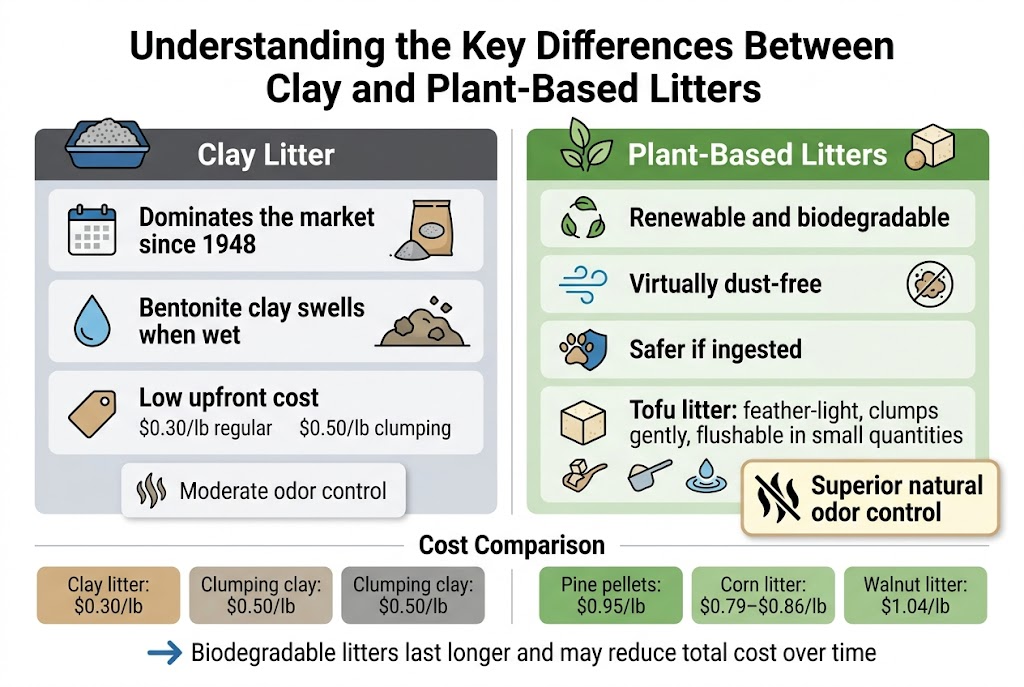
Clay litter established its dominance in 1948, revolutionizing pet care by replacing primitive materials like sand and fireplace ashes. Even after 70 years, it remains the standard choice for most cat owners, primarily due to its exceptionally low cost compared to alternative litter types.
The effectiveness of clay litter stems from bentonite clay's unique properties. When exposed to moisture, bentonite clay swells dramatically, forming tight, solid clumps that are remarkably easy to scoop from the litter box. This clumping action also provides moderate odor trapping capabilities, making maintenance more manageable for pet owners.
Clay litter's absorbent nature makes it particularly effective at managing liquid waste. Clumping variations offer enhanced odor control compared to non-clumping alternatives, which explains why many cat owners gravitate toward these premium clay options despite the higher cost.
How Plant-Based Alternatives Offer Superior Performance
Plant-based litters represent a significant advancement in performance and safety. These biodegradable options are renewable and sustainable, offering a healthier alternative that addresses many concerns associated with traditional clay products. Most notably, plant-based litters are virtually dust-free and completely lack silica dust, eliminating respiratory concerns for both cats and their owners.
The safety profile of plant-based litters extends beyond dust concerns. These alternatives are generally not harmful if ingested, providing peace of mind for cat owners whose pets may consume small amounts during grooming.
Tofu litter exemplifies the superior characteristics of plant-based options. This innovative material is feather-light, making handling and disposal significantly easier than heavy clay alternatives. It clumps gently yet effectively, maintains super low-dust properties, and offers the unique advantage of being flushable in small quantities.
Perhaps most impressively, plant-based alternatives like tofu provide superior natural odor control compared to clay options. This enhanced performance comes from natural properties inherent in organic materials, rather than artificial fragrances or chemical additives.
Cost Comparison: Why Price Doesn't Tell the Full Story
The initial price difference between clay and plant-based litters appears substantial. Regular clay litter averages $0.30 per pound, while clumping clay litter costs approximately $0.50 per pound. In contrast, biodegradable alternatives command higher prices: pine pellet litter costs around $0.95 per pound, corn-based litters range from $0.79 to $0.86 per pound, and walnut-based litter averages $1.04 per pound.
However, this surface-level comparison fails to reveal the complete economic picture. Pound for pound, biodegradable litter tends to last significantly longer than clay litter, extending the time between purchases and reducing overall consumption. The superior absorption and clumping properties of many plant-based options mean less product is needed for effective waste management.
When considering the potential health and environmental issues associated with clay litter, the lower upfront price may not represent true savings. The hidden costs of health concerns, environmental impact, and potentially more frequent litter changes make plant-based alternatives increasingly attractive from a total cost perspective.
Health and Safety: Why Your Cat's Wellbeing Depends on Litter Choice
Hidden Dangers of Clay Litter for Respiratory Health
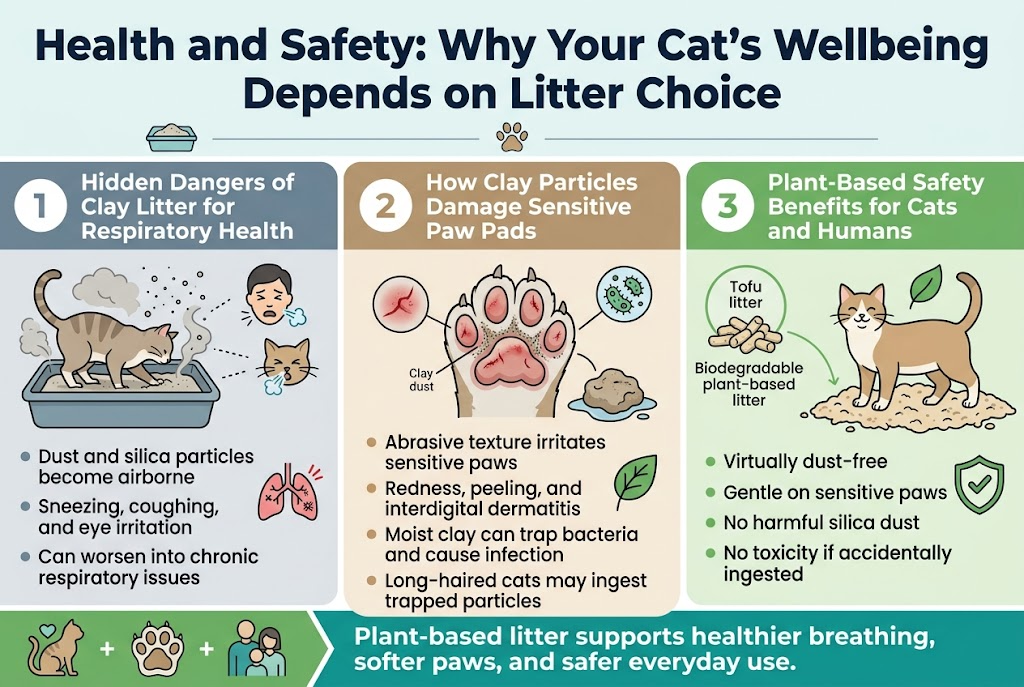
Clay litter poses significant respiratory health risks due to its inherently dusty composition. When cats dig and scratch in their litter box, fine particles become airborne, creating potential lung irritation for both felines and their human companions. This dust contains silica particles that can penetrate deep into the respiratory system.
Cats with sensitive respiratory systems are particularly vulnerable to these effects. The stirred-up dust frequently triggers sneezing, persistent coughing, and noticeable eye irritation in susceptible cats. These symptoms can worsen over time with continued exposure, potentially developing into chronic respiratory issues that compromise your cat's overall health and comfort.
How Clay Particles Damage Sensitive Paw Pads
Now that we've covered the respiratory concerns, the physical damage to your cat's paws presents another serious health consideration. Cats naturally have extremely sensitive paw pads, and constant exposure to the abrasive texture and fine dust of bentonite clay creates multiple complications. Regular contact can result in visible redness, uncomfortable peeling, and even interdigital dermatitis between the toes.
The microscopic clay particles create additional problems by adhering to your cat's paws, gradually drying out the delicate paw pad skin. This desiccation process can lead to small cuts and painful peeling, making walking and normal scratching behavior uncomfortable.
Wet clay compounds these issues by trapping moisture, establishing ideal conditions for bacterial growth. When bacteria seep into existing paw cuts or compromised skin, inflammation and secondary infections frequently develop. Long-haired cats face additional risks, as clay particles become embedded in their fur and between their toes, leading to accidental ingestion during routine grooming and potential digestive upset.
Plant-Based Safety Benefits for Cats and Humans
With these clay-related health concerns in mind, plant-based alternatives offer remarkable safety advantages. Biodegradable litters are virtually dust-free formulations that contain no harmful silica dust, dramatically improving respiratory health conditions for both cats and their human families.
Tofu litter exemplifies these safety benefits through its composition of soft, dry materials that remain gentle on sensitive cat paws. Unlike clay alternatives, these plant-based options contain no harsh chemicals or aggressive clumping agents that might irritate delicate skin.
Perhaps most importantly, plant-based litters present no toxicity concerns if accidentally ingested—a crucial safety advantage over traditional clay options. This characteristic makes tofu litter particularly valuable for cats recovering from surgical procedures or managing existing skin conditions, as the gentler formulation helps minimize irritation during vulnerable healing periods.
Environmental Impact: Making an Eco-Conscious Choice
Strip Mining and Ecosystem Destruction from Clay Production
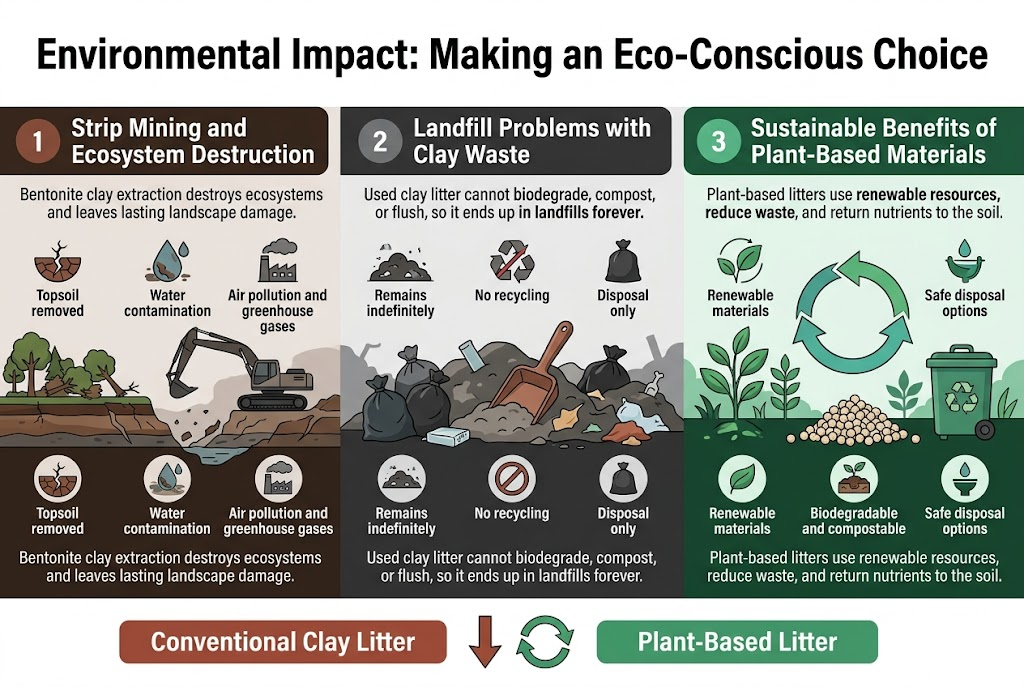
Clay litter production relies heavily on strip mining practices that cause extensive environmental damage. The extraction of bentonite clay, the primary component in traditional cat litter, involves removing large sections of topsoil and vegetation to access clay deposits beneath the surface. This destructive mining process leads to the complete destruction of local ecosystems, permanently altering landscapes that took centuries to develop.
The environmental consequences extend beyond immediate habitat loss. Strip mining operations contaminate water sources through runoff and chemical leaching, affecting both groundwater and surface water quality in surrounding areas. The extraction process requires energy-intensive machinery that operates continuously, contributing to air pollution and greenhouse gas emissions. These operations leave lasting scars on the landscape, creating barren areas where vegetation struggles to regrow even after mining activities cease.
Landfill Problems with Non-Biodegradable Clay Waste
Clay litter presents significant waste management challenges due to its non-renewable and non-biodegradable nature. Once used, clay litter cannot break down naturally, meaning every pound disposed of remains in landfills indefinitely. This permanent accumulation contributes to the growing crisis of landfill capacity, as millions of tons of used clay litter pile up year after year with no natural decomposition process.
The disposal limitations of clay litter further compound the environmental problem. Unlike some alternatives, clay litter cannot be flushed, restricting disposal options to plastic trash bags destined for landfills. As a strictly one-time use product, clay litter offers no recycling possibilities, making it a linear waste product that moves directly from production to permanent disposal without any opportunity for recovery or reuse.
Sustainable Benefits of Plant-Based Renewable Materials
Plant-based litters offer a dramatically different environmental profile through their use of renewable and sustainable materials. These biodegradable alternatives are manufactured from materials that can be continuously replenished, creating a sustainable cycle rather than depleting finite natural resources. The production process typically has a much lower environmental impact compared to strip mining operations.
Tofu litter exemplifies the innovative approach of plant-based alternatives by utilizing food production leftovers that would otherwise become waste. This secondary use gives materials a valuable second life while simultaneously diverting organic waste from landfills. The circular economy approach transforms what would be food industry waste into a useful product, maximizing resource efficiency.
The end-of-life benefits of plant-based litters are equally impressive. These materials decompose naturally, avoiding the long-term environmental pollution associated with non-biodegradable alternatives. Many plant-based litters are fully compostable, allowing cat owners to return nutrients to the soil rather than adding to landfill waste. Tofu litter provides additional disposal flexibility, as it can be composted or, in small quantities, safely flushed. This versatility reduces reliance on plastic trash bags for disposal, further minimizing the environmental footprint of cat care routines.
Practical Performance Comparison for Daily Use
Dust Control and Tracking Issues Between Options
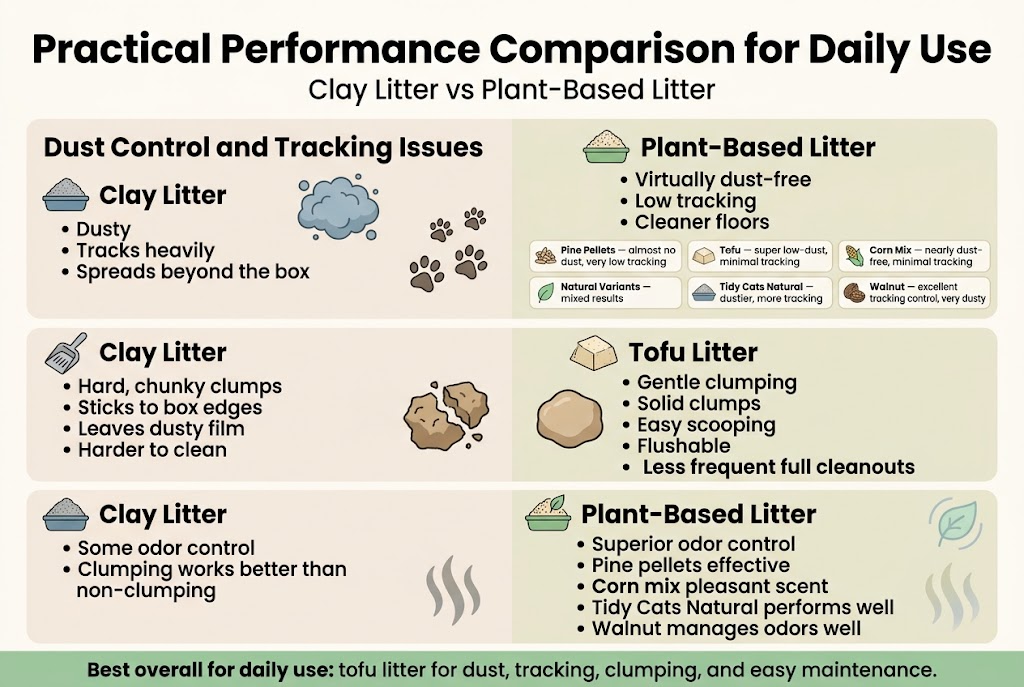
When it comes to daily use, the difference between clay and plant-based litters becomes immediately apparent in how they handle dust and tracking. Clay litter is notorious for being dusty, with particles frequently spreading well beyond the litter box area. This creates additional cleaning work and can potentially affect air quality in your home. A significant amount of clay litter typically gets tracked out of the box on your cat's paws, creating messes throughout your living space.
Plant-based alternatives offer a stark contrast in performance. Most biodegradable litters are virtually dust-free and exhibit remarkably low dust levels during pouring and scooping. Pine pellet litter stands out particularly well in this category, causing very little tracking due to its larger pellet size while producing almost no dust.
Different plant-based options vary in their tracking control effectiveness. Tofu litter performs exceptionally well, being super low-dust while minimizing tracking significantly. Arm & Hammer corn mix litter is nearly dust-free and tracks minimally, making it an excellent choice for maintaining cleaner floors. However, not all natural options excel equally - Tidy Cats Natural litter is noted for being dustier and tracking more than other plant-based alternatives. Naturally Fresh Walnut litter presents a mixed performance, offering excellent tracking control but being described as incredibly dusty.
Clumping Quality and Ease of Cleaning
The clumping characteristics between clay and plant-based litters reveal significant differences in daily maintenance ease. Clay litter forms hard, chunky clumps when wet, which can become problematic during cleaning. These rigid clumps often stick stubbornly to the edges and bottom of the litter box, making removal challenging and time-consuming. Additionally, cleaning with clay litter frequently leaves behind a dusty film that requires extra effort to eliminate.
Tofu litter demonstrates superior clumping performance for everyday use. When wet, it clumps gently, making scooping straightforward and box cleaning much simpler. The clumps formed are solid and resistant to breaking apart, preventing the creation of a muddy mess that can complicate maintenance. This gentle yet effective clumping action translates to less frustration during daily scooping routines.
A significant advantage of tofu litter is its flushable nature, offering an easy disposal method without requiring special waste handling procedures. This convenience factor, combined with its superior clumping properties, means tofu litter requires less frequent full cleanouts of the entire litter box, reducing both time and effort in long-term maintenance.
Odor Control Effectiveness in Real-World Conditions
Odor management performance varies considerably between different litter types in actual household conditions. Clay litter provides some level of odor control, with clumping versions generally being more effective than non-clumping alternatives. However, this basic odor control may not be sufficient for households with multiple cats or those requiring superior freshness.
Plant-based litters demonstrate impressive odor control capabilities across various formulations. Tofu litter offers superior natural odor control that outperforms traditional clay options. Pine pellet litter effectively controls odors through its natural properties, making it an excellent choice for odor-sensitive households.
Other plant-based options also show strong performance in real-world conditions. Arm & Hammer corn mix litter effectively keeps odors down while providing a pleasant scent that quickly becomes subdued rather than overwhelming. Tidy Cats Natural litter performs well in odor control despite its tracking issues. Naturally Fresh Walnut litter also effectively manages odors, demonstrating that plant-based materials can provide excellent odor control without relying on artificial fragrances or harsh chemicals.
Special Considerations for Different Cat Needs
Best Litter Choices for Kittens and Senior Cats
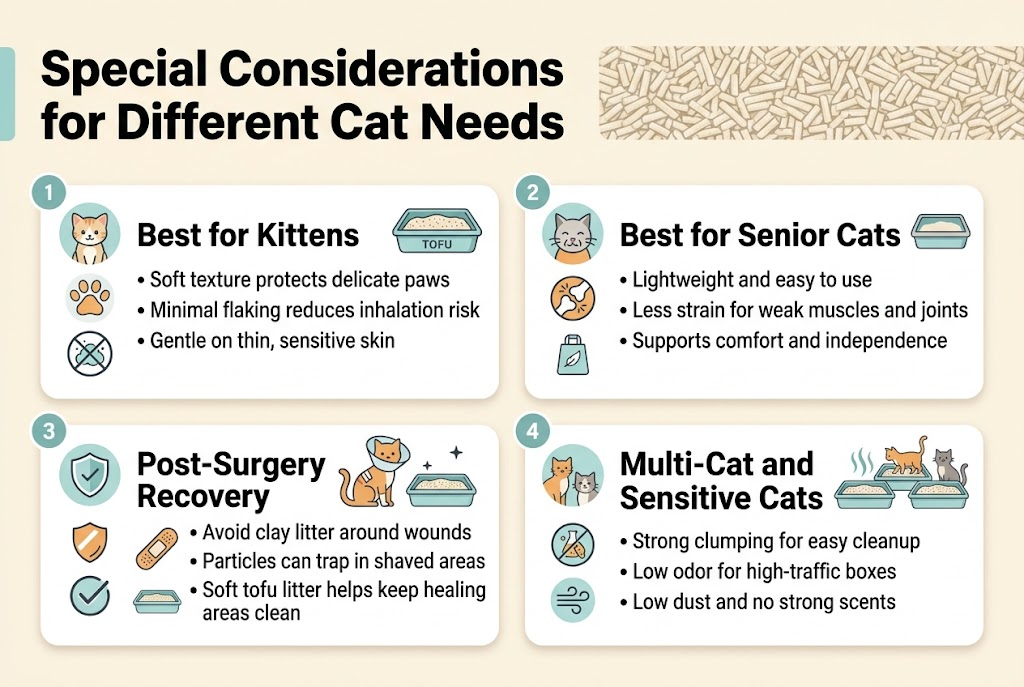
Kittens require special consideration when selecting litter due to their delicate physiology. Their skin is notably thin and tender, making tofu litter an optimal choice for these young felines. The soft texture of tofu litter provides a gentle surface that won't irritate their sensitive paws or skin. Additionally, tofu litter produces minimal flaking, which significantly reduces the risk of kittens inhaling dangerous particles that could compromise their developing respiratory systems.
Senior cats face different challenges that make litter selection equally important. As cats age, they often develop joint issues or experience weakened muscles, making mobility more difficult. Tofu litter addresses these concerns through its lightweight composition, making it easier for senior cats to navigate their litter boxes without strain. The reduced physical effort required when using tofu litter provides comfort and helps maintain their independence during their golden years.
Post-Surgery and Medical Recovery Requirements
Cats recovering from surgery or dealing with wounds require exceptionally careful litter management to prevent complications. Clay litter poses significant risks during recovery periods, as particles can easily become trapped in shaved surgical areas or around wound sites, potentially leading to serious infections.
Tofu litter emerges as the superior choice for medical recovery situations. Its composition keeps healing areas cleaner and provides a soft surface that won't scratch or disturb sensitive, recovering skin. This gentler option ensures that post-operative care remains optimal, reducing the likelihood of complications and promoting faster healing for cats during their most vulnerable recovery periods.
Solutions for Multi-Cat Households and High-Traffic Boxes
Multi-cat households present unique challenges that demand efficient odor control and easy maintenance solutions. The increased usage of litter boxes in these environments requires a product that can handle heavy traffic while maintaining cleanliness and freshness.
Tofu litter proves well-suited for multi-cat homes due to its superior performance characteristics. It clumps solidly, making waste removal more efficient and thorough. The low odor properties of tofu litter help manage the increased waste production typical in multi-cat environments. Furthermore, its fast clumping ability helps keep boxes cleaner for extended periods, reducing the frequency of complete litter changes and making maintenance more manageable for cat owners dealing with multiple felines.
For cats with allergies or breathing issues, tofu litter offers additional benefits as a low-dust option with no strong scents, making it ideal for sensitive felines who might otherwise suffer from sneezing, coughing, or eye irritation that clay litter can trigger.
Top Plant-Based Litter Options Worth Considering
Pine Pellet Litter Benefits and Limitations
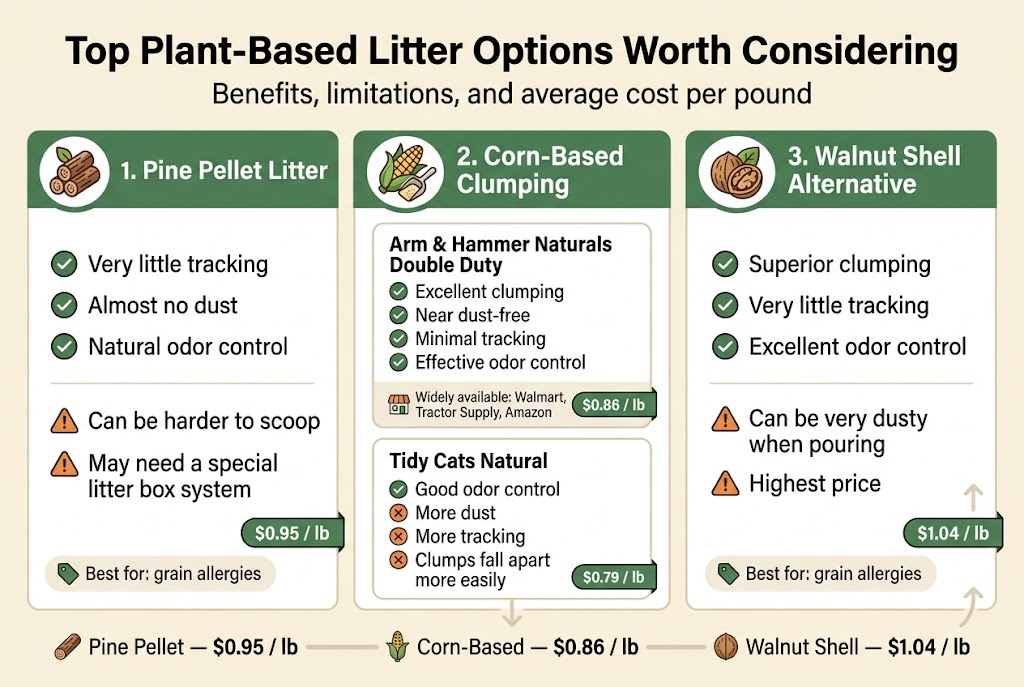
Pine pellet litter, crafted from 100% recycled pine or other wood materials, stands out as an exceptional choice for cat owners seeking minimal maintenance and superior performance. This option delivers remarkable advantages including very little tracking, ensuring your floors stay clean, and almost no dust production, making it ideal for both cats and humans with respiratory sensitivities. The natural odor control properties are particularly impressive, while the litter's durability potentially makes it last longer than other biodegradable alternatives available on the market.
For cats with grain allergies, pine pellet litter provides a safe haven, eliminating concerns about corn, wheat, or other grain-based ingredients that might trigger adverse reactions. However, this litter type does present some practical challenges. The unique pellet format can be challenging to scoop without a specialized litter box system, which may require an initial investment and adjustment period for both cat and owner. At an average cost of $0.95 per pound, pine pellets fall into the mid-range pricing category for plant-based options.
Corn-Based Clumping Performance and Availability
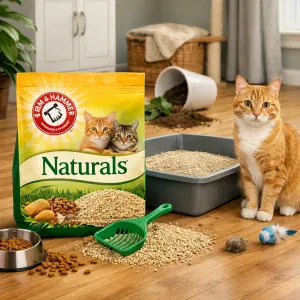
Now that we've covered pine options, corn-based litters offer compelling clumping alternatives that closely mimic traditional clay performance. Arm & Hammer Naturals Double Duty Clumping Litter exemplifies premium corn-based formulation, utilizing natural corn fibers combined with a plant-based clumping agent, baking soda for enhanced odor absorption, and mineral oil specifically for dust control. An artificial fragrance adds a pleasant scent that many cat owners appreciate.
This corn-based option has earned favor among users for its excellent clumping ability, near dust-free composition, minimal tracking properties, and effective odor control system. The combination of ingredients creates solid, scoopable clumps that maintain their integrity during removal. Arm & Hammer Naturals is widely available through major retailers including Walmart, Tractor Supply, and Amazon, though availability can sometimes be inconsistent across different locations. At $0.86 per pound average cost, it represents good value for premium plant-based performance.
Alternatively, Tidy Cats Natural presents another corn-based option that incorporates cedar and pine elements for enhanced odor control while relying on corn for primary absorbency. However, this formulation tends to be dustier and exhibits more tracking compared to other premium options. The clumps, while functional, are less solid and tend to fall apart more easily during scooping, though odor control remains effective. This option comes at a lower price point of $0.79 per pound average cost.
Tofu and Walnut Shell Alternatives for Sensitive Cats
With these mainstream options in mind, specialized alternatives provide solutions for cats with specific sensitivities or unique requirements. Naturally Fresh Walnut Based Litter, manufactured from 100% walnut shells, delivers superior clumping performance compared to corn-based alternatives. This innovative material creates exceptionally solid clumps while producing very little tracking, making cleanup more manageable.
The walnut shell composition offers excellent odor control properties and serves as another outstanding choice for cats with grain allergies, completely avoiding corn, wheat, and other common allergens. However, potential users should be aware that this litter can be incredibly dusty during pouring and initial setup, which may require careful handling and potentially affect cats or owners with dust sensitivities.
While walnut shell litter provides premium performance characteristics, it comes at the highest price point among plant-based options at an average cost of $1.04 per pound. This investment reflects the specialized processing required for walnut shells and the superior performance characteristics, making it a premium choice for discerning cat owners who prioritize performance over cost considerations.
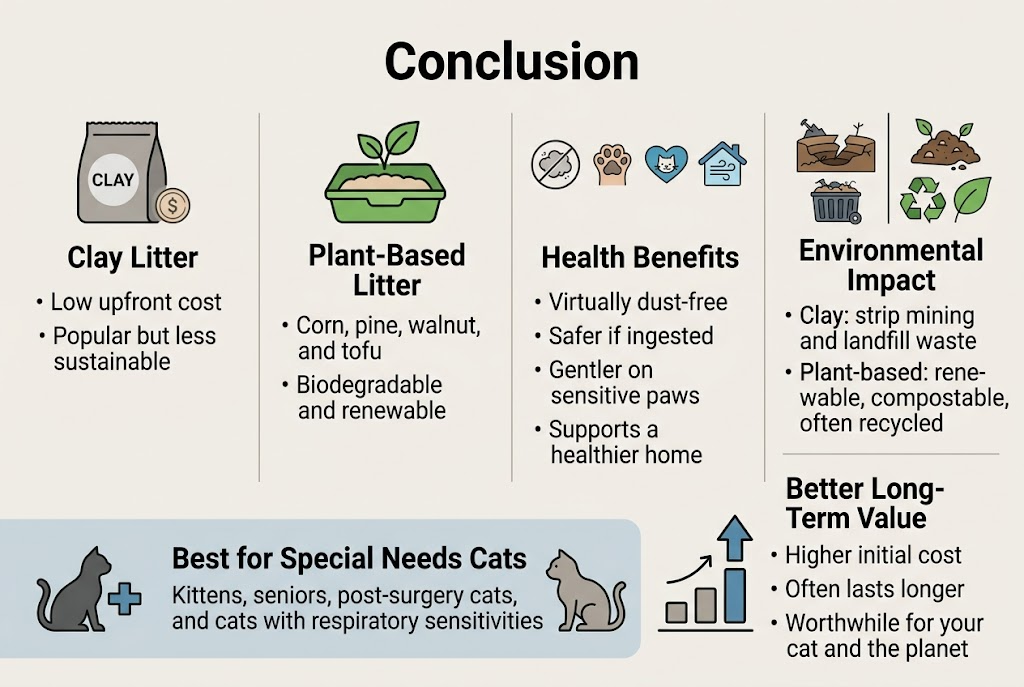
Choosing between clay and plant-based cat litter ultimately comes down to weighing cost against health, environmental impact, and performance benefits. While clay litter remains popular due to its low upfront cost, plant-based alternatives like corn, pine, walnut, and tofu litters offer significant advantages for both cats and their owners. These biodegradable options are virtually dust-free, safer if ingested, gentler on sensitive paws, and contribute to a healthier home environment.
The environmental benefits of plant-based litters cannot be overlooked. Unlike clay litter, which requires destructive strip mining and contributes to landfill waste, plant-based options are renewable, compostable, and often made from recycled materials. For cats with special needs—including kittens, seniors, post-surgery cats, or those with respiratory sensitivities—the switch to plant-based litter can make a meaningful difference in their comfort and health. While the initial investment may be higher, many cat owners find that plant-based litters last longer and provide better overall value, making them a worthwhile choice for your feline companion's well-being and the planet's future.